Scheer Family Portraits


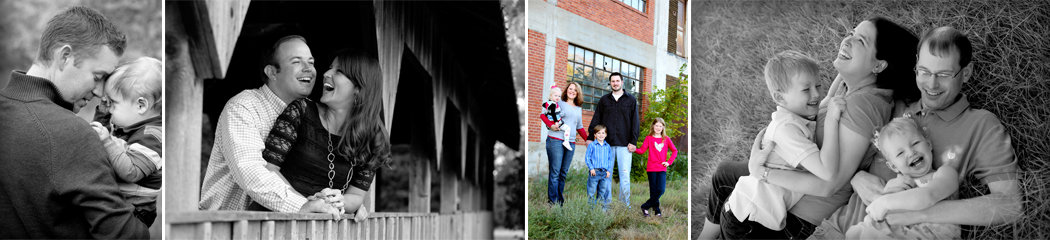
I'm going to interrupt Karen and her African tales for just a bit to post a few selects from the Scheer family portrait session we did right before Christmas. The Scheers are a large family who live out near Garden Plain and are relatives of mine though marriage. There were more than 30 of them gathered for a Christmas feast so we set up the studio in their living room. These aren't all the pictures we made, but are a few of my favorites and are a sample of our family portrait session. While we are able to shoot "in the studio" while on location, we also prefer to shoot outdoor environment portraits, as well.


Kaleb and Makenzie, brother and sister.


Claire and Megan, sisters.


This headshot is amazing on anyone, but especially adorable on Kaleb sporting a toothless grin!


Dee and Stacy, wife and husband, mother and father.


Kathy and Gregg, still in love.

Village life

On to life in the village. Jeanel was sick in bed (probably with amebas), so some of the women who lived near by took me out to show me some of the common daily activities.

Millet is a grain and it’s one of the major crops in that region of Niger. Jeanel is a agriculture volunteer, so she’s worked with better ways to cultivate crops, as well as encouraging storage and “grain banks.”


First, the women sift through the millet to get the chaff out of it. This little kiddo was crawling about, playing until I showed up. Then she just started screaming and being shy. I think it had to do with me being a strange, white person.


It’s interesting to watch them pound millet because they might start with the pounder in the right arm, then after a few pounds, put both hands on it, then after another few pounds, switch to the left arm. This process is repeated infinitely until the pounding is over.

The pounding itself makes a melodic sort of sound. It’s constant, and if you have a few women doing so, it’s almost musical.

And yes, I tried this pounding business and it’s hard work. These women must have arms of steel, because my weak American arms were done after about a dozen pounds!


Then, they put it into a wooden bowl-like item (I have NO IDEA what it’s called….) with some water and start pounding away.


While mom is attending to work, the kids seem to do whatever. This little girl was occupying her time on the side of one of the pounding bowls.


Once it’s pounded, they’ll soak it a little, but since I don’t speak Hausa, I don’t know the reason for this process.


There is a process where the millet went back and forth between a bowl and pot for awhile.


The goat thought it might just help itself to a snack during the process. I was a little shocked at first to see that, but no one else seemed bothered by it.


Oh, then it wasn’t just one goat. They seem to multiply around that place and love to get into the food.


She paused for a break, and her daughter also helped herself to some of the millet compound.

This is one of my favorite photos from the trip, because it sort of shows life for these women. Most of the women I saw were pregnant (as she is on the right). If they were not, then they were nursing an infant. Once the babe is weaned, they’re back to pregnant again. I was amazed by this, but Jeanel said the average women has 8 living child. I repeat, LIVING. This does not account for infant mortality rates, stillbirths or any other complications that might cause a child’s death.


Women seem to carry everything on their heads. So do the kids. I asked Jenel about this and she says they have strong neck muscles to do the job. I kept looking and thinking of the American version of strong neck (read: THICK neck), but didn’t see a thick, beefy neck among them.


Chores such as gathering water begins early for the girls. This is on the way back into town from the well. I was on my tip toes on the other side of a wall, trying to take this picture, which the girl thought was pretty funny because she kept laughing at me.


I got a lot of this … staring at me. They completed a new house, and the tradition is to pound the floor with sticks. Well, I went into the house alone, without Jeanel my protector. They started staring at me.

With grunts and points and gestures, I got them to start pounding, but they kept STARING at me. Oh well.


Women's literacy class

In addition to working on building a well for her village, Jeanel organized a women's literacy class. It is open to women of all ages, and was interesting to attend. This is my experience of one day of class.


Jeanel taking supplies to the school for literacy class. The women’s literacy class is in the building on the left side.


Waiting and waiting on the women to show up. They knew class was going on, but we waited more than 2 hours for them to show up. Evidently, the sense of time is a little different in Niger. Especailly with the women. The men have more of a sense of showing up on time, Jeanel said, because at the Mosquee, they have scheduled prayer time. They show up or they miss it. With the women, you have to wait on them to show up. In all fairness, the class begins near noon, so they had to be sure the chores and items around the house were in order before showing up. AND class began on a Saturday, so kids weren’t in school. Normally, when the kids stream from the building, they know it’s time for class. Without the kids’ school schedule and break from noon to 3 p.m. it is more difficult.


The class straggled in. These were two of the first women, and they had their babies with them (where else would the kids go?). I kept trying to do some interesting layering with the foreground and background with two babies….


Once enough women show up, class begins. The part I found most humorous was that the teacher wore his shades during the entire class. Oh well, the light in that school room was gorgeous!


This woman came for awhile, stood around and then left. Things were really come and go … which would be difficult for me if I were teaching, but it seems to be more common in Niger.


I really like the cloth I saw people wear in Niger. Some of it had the most beautiful embroidery on it. The women will often purchase cloth at market, then have it tailored into an outfit for them to wear.


Jeanel visiting with one of the women students. Our time before the class began wasn’t wasted. We spent most of one of the hours trying to sharpen pencils. She had a small hand sharpener and a bunch of pencils provided by the country. BUT the wood was really soft and made it nearly impossible to get a good, sharp pencil. If we did, it likely broke once someone started writing with it.

I am in the process of gathering pencils, pens and a decent manual sharpener to send to Jeanel for her class…


I grabbed a few close shots, which I really liked. I wanted to shoot more close, but Jeanel asked me to sit down. The women didn’t mind me photographing, but they minded my clothes. Huh? I was wearing light-colored pants and sat on a filthy rock. The seat of my pants was all dirty and the women kept commenting about it. “Rahila, tell her to sit on burlap when she sits on the rock. Tell her that her pants are dirty…” and on and on. It was so distracting to them that Jeanel just told me to hang out in the back of the room.

Not a big deal, but I only had my wide angle lens with me and I really wished I had another, longer lens. Oh well, that was the ONE time in my entire trip I had those thoughts, so that’s really good. It means I packed just the right amount of photography gear.


More of writing on the board. The babies go right along for everything, with school being no different.


Class is over, after about 2.5 hours. They are dedicated and have more patience to work on it than I do/did. But then we waited a few extra hours for them to show up, which is probably why I was antsy for class to be over.

Karen + camel

Ok, so it’s about time to post some pictures of ME being crazy in Africa. While we were in Jeanel’s village, Guidan Ila, I was able to take a ride around the block on a camel! My friend, Jeanel, was gracious enough to photograph the experience! So most of these photos in this particular post are hers.


I met the fella here, and thought I better say hello before we took off.


He seemed safe enough. One of the girls in the village if I was scared … I think she asked if I thought he would eat me. I replied that camels don’t eat people, which she found riotous.


This fist up in the air is one of the things I saw a lot from the women in the village. I guess it’s sort of like a thumbs up sign…like in solidarity or something. Evidently the thumbs up action has some political connotations in Niger.


Once they brought the camel out, they were ready for me to hop on, as is. Ther’s a tuft of hair on the top of the camel’s hump that they told me to hold on to Jeanel told them I would not be riding without a saddle, so they strapped one on for me.


More saddle strapping.


They helped me up and basically gave me one instruction: “Hold on tight.” OK!


Me and the camel on the open range!


This is the only one of two photos in this bunch taken by me. It’s my view from atop the camel, my view of my leader and of course, Jeanel (right).


I felt like the pied piper, with a line of children following me. This is the gaggle of kiddos after they turned the camel around!


More of me being a goof. The fella that was leading the camel told Jeanel it was sort of like a wedding procession. In their custom, the bride is carried from her parents house to the groom’s house. It can be via a camel, donkey cart or just people picking her up. I guess people follow behind in a procession like this. Only I’m not a bride and we’re going to no groom’s house. J


My favorite part of this one is the spring in the kid’s step on the left side of the frame. To me, this really makes the picture interesting.